
The Mexican Bank Trust: How US Citizens Own Property Safely
When people ask how much an investment in a beach property yields, they usually think of rental income or capital appreciation—as if they were two separate things. They’re not. At Seascape, they’re one and the same: the integrated return. And understanding that difference can completely change the way you evaluate where to invest your money.
Executive Summary:
|
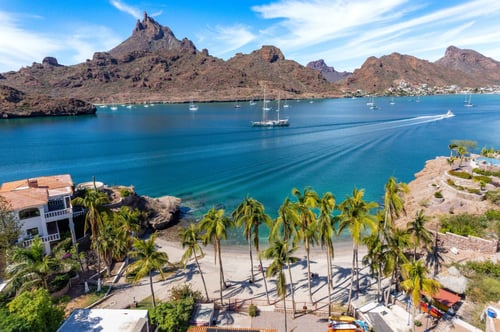
Investing in a condo overlooking the Sea of Cortez in San Carlos isn’t just about buying a tangible asset in Mexico’s only destination recognized by National Geographic for its cuisine—it’s about building a return that combines two simultaneous sources of growth: vacation rental income that generates cash flow while the property is available, and capital appreciation that builds value year after year. The Seascape model, with an entry price starting at $1.1M MXN in Smart Ownership, projects an integrated CAGR of between 10% and 18% annually under a conservative scenario based — comparable to or higher than CETES, FIBRAs, and the stock market, with the advantage of a physical asset that you can use, pass on to your heirs, and enjoy. These figures are reference scenarios based on market assumptions. They are not a guarantee of performance. |
The Most Common Mistake When Evaluating a Beach Investment
Most investors considering a vacation property project ask one of two questions: “How much rental income will it generate?” or “How much will it appreciate in value?” They rarely ask both at the same time—and that leads them to underestimate the actual return.
An apartment in Mexico City rents well but appreciates slowly. A CETE pays interest but does not generate an asset. A FIBRA pays dividends but offers no control or personal use. Seascape in San Carlos combines all three advantages into a single model: rental income, asset appreciation, and guaranteed personal use.
The integrated return doesn’t simply add two numbers—it multiplies them over time.
What Is Integrated Return and Why Does It Matter
The integrated CAGR (Compound Annual Growth Rate) is the metric that converts an investment’s total accumulated gain into an equivalent annual percentage. It doesn’t measure just rental income or just capital appreciation—it adds them together, projects them over a time horizon, and expresses them as a single number comparable to any other investment on the market.
At Seascape, the integrated CAGR is calculated as follows:
Cash Yield (rental yield) — the net cash flow generated by the property when it is rented. In the Smart Ownership model , with 4 weeks rented out of the 6 available per year, the cash yield is 3.1% annually on the investment for any unit type (1BR, 2BR, or 3BR). That isn’t much on its own—but it isn’t the only factor.
Annual Capital Appreciation — the increase in the property’s value. The Seascape model uses 10% annually as a conservative scenario, which is the floor of what real estate projects in established tourist areas in Mexico have recorded. San Carlos, as a rapidly growing destination—now recognized by National Geographic—has the potential for a higher base-case scenario.
Integrated CAGR = combined rental income + capital appreciation over time. With 4 weeks of rental income and a conservative capital appreciation rate of 10%, the integrated CAGR for a 1BR Smart Ownership unit is 13.1% annually. With a base capital appreciation rate of 15%, it rises to over 17%. And that’s before considering the cash payment plan, which improves the return by approximately 12 additional percentage points.
The Four 10-Year Capital Appreciation Scenarios
The Seascape model projects four scenarios for a Smart Ownership 1BR with an initial investment of $1.14M MXN:
|
Scenario |
Annual Capital Appreciation |
Value After 10 Years |
Cumulative Net Gain |
|
Conservative |
10% |
$1,253,596 |
$113,963 |
|
Base |
15% |
$1,310,578 |
$170,945 |
|
Optimistic |
20% |
$1,367,559 |
$227,927 |
|
Aggressive |
25% |
$1,424,541 |
$284,908 |
The conservative scenario is the one used by Seascape as a benchmark. Comparable projects in the region have reported annual capital appreciation rates ranging from 12% to 30%—10% is the conservative floor, not the expected ceiling.
Smart vs. Full: Same Percentage Return, Different Check Amount
One of the most frequently asked questions from investors is whether Smart Ownership or Full Ownership is a better option. The answer lies not in the percentage return—since it’s nearly the same—but in the investment profile and available capital.
Smart Ownership (1/8 share) —investment of $1.1M to $2.2M MXN, 6 weeks available per year, operating costs shared among 8 co-owners, compound CAGR of 13–18%.
Full Ownership —investment of 7.1M to 13.2M MXN, 52 weeks available, higher absolute cash flow in pesos, integrated CAGR of 16–19%.
The difference of ~3 percentage points in CAGR in favor of Full Ownership is explained by economies of scale and the VAT cost associated with Smart Ownership. But in terms of relative return, both models compete well: the decision comes down to how much capital you want to commit and how involved you want to be in the operation.
How it compares to other investments
|
Investment |
Typical Annual Return |
Tangible asset |
Personal use |
|
CETES / Fixed Income |
9–11% |
No |
No |
|
FIBRAs |
8–12% |
Indirect |
No |
|
S&P / BMV |
10–14% |
No |
No |
|
Apartment in Mexico City (rental) |
4–6% |
Yes |
Yes |
|
Seascape Smart |
10–18% CAGR |
Yes |
Yes |
|
Seascape Full |
12–19% CAGR |
Yes |
Yes |
CETES offer interest—not equity. When benchmark rates fall, your income falls with them, and you have nothing to pass on to your heirs. The stock market offers returns but with high volatility and no control. An apartment in Mexico City generates rent, but on the secondary market and without the upside of a presale in an emerging destination. Seascape combines the best of each category.
The Impact of the Payment Plan on Your Return
One variable that few investors consider at the outset is that the payment plan changes the actual purchase price—and therefore the return on capital appreciation.
At Seascape, the payment options and their approximate impact on the ROI from capital appreciation are:
- Cash — 10% discount off the list price. Your ROI from capital appreciation increases by ~12 percentage points in any scenario. The most profitable sale for both parties.
- 12 months — list price, no adjustment. This is the baseline scenario.
- 24 months — 8% premium. The return decreases proportionally.
- 36 months — 16% premium. In a conservative scenario with 10% capital appreciation, the return on appreciation may become negative.
The conclusion is straightforward: the closer you are to the list price, the higher your actual return. It’s worth negotiating the down payment terms to get as close as possible to the arrangement that benefits you the most.
Why San Carlos Is the Right Location for This Investment
The return on any real estate investment doesn’t exist in a vacuum—it depends on the destination. And San Carlos has just taken a leap in visibility that few destinations in Mexico have achieved: National Geographic included it as the only location in Mexico on its list of the world’s best culinary destinations for 2026, alongside Crete, Singapore, and Tasmania.
That’s not just a headline. It’s the kind of recognition that historically precedes sustained increases in tourism demand, vacation rental income, and real estate appreciation. San Carlos was already showing positive trends before this recognition—now it has the wind at its back thanks to international attention.
For luxury beachfront condos in a destination with this profile, entry timing matters. Most value growth happens before a destination goes mainstream — and Sonora just crossed that threshold.
If you’re wondering whether it’s a good idea to invest in San Carlos in 2026, the market’s answer today is that the catalysts are aligned: international recognition, a still-limited supply of high-quality properties, and a fractional ownership model that lowers the barrier to entry.
How does the Smart Ownership model work in practice?
The co-ownership real estate mexico at Seascape is different from traditional timeshare. You're not buying the right to use a space — you're buying a legal fraction of the property, with proportional rights to use, appreciation, and sale.
Each unit is divided into 8 shares. As a co-owner, you have 6 weeks per year for personal use, and the weeks you don’t use can be rented out through the vacation management program. Operating costs—HOA fees, maintenance, and administration—are shared among the 8 co-owners.
For international buyers, the bank trust Mexico real estate, the legal instrument that guarantees full property rights in Mexico's coastal zones.
Frequently Asked Questions
What annual return can be expected from a beachfront real estate investment in Sonora?
At Seascape, the model projects an integrated CAGR of 10% to 18% annually in a conservative-to-base scenario, combining cash yield from rentals (3.1% in Smart, up to 7.5% in Full) with annual appreciation of 10% to 15%. These are reference scenarios, not guarantees, but the destination's fundamentals — international recognition, growing demand, and limited supply — support the range.
Is Smart Ownership or Full Ownership the better financial choice?
The percentage return is similar in both models. The difference is the capital to commit: Smart starts at $1.1M MXN with 6 weeks of availability and shared costs; Full requires $7.1M–$13.2M MXN but offers greater absolute cash flow and full control. The decision depends on investment profile, not return rate.
How does the payment structure affect investment returns?
Significantly. Paying cash with the 10% discount improves ROI from appreciation by approximately 12 percentage points versus list price. Conversely, financing over 36 months at a 16% premium can make the appreciation return negative in a conservative scenario. The payment structure is as important a variable as the projected appreciation rate.
Conclusion: Two Sources, One Return
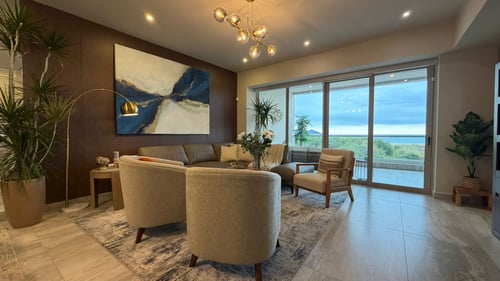
Investing in a beachfront property at Seascape isn’t a bet on a single variable—it’s a combination of rental income and property appreciation in one of Mexico’s most promising coastal destinations. An integrated CAGR of 10% to 18% annually, a tangible asset overlooking the Sea of Cortez, guaranteed personal use, and the assurance of being in the only place in Mexico that the world has just recognized for its cuisine.